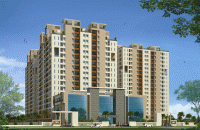
58.2 Mn Sq. Ft. and Counting - India's Grade A Office Boom Leaves
Mid-Tier Behind
· Net Grade A office
absorption across India's top 7 cities hit 58.2 Mn sq. ft. in 2025, up 17% YoY
& market's best year on record - Bengaluru, Hyderabad & Chennai
accounted for 50% of national absorption: Q1 2026 at 13.5 Mn sq. ft.
· GCCs are now nearly
50% of India’s office market with gross leasing up from 36% in 2024 to 41% in
2025 & further to 47% in Q1 2026; Bengaluru alone absorbed 40% of all GCC
leasing in Q1 2026
· Grade A vacancy down
from 16.5% (2024) to 15.5% (Q1 2026), mid-tier & secondary stock languishes
at 20–25% with poor recovery prospects
· Avg. monthly Grade A
rentals up 6% to INR 92/sq. ft. in 2025 & to INR 93 in Q1 2026 - Bengaluru
leads with 11% QoQ growth as occupiers pay a 20% premium over mid-tier
alternatives
· Top 7 cities added 52
Mn sq. ft. of new Grade A supply in 2025 (+8% YoY) - GCC to hit 2,200–2,300
centres worth USD 100-110 Bn by 2030 & almost entirely occupy Grade A stock
Mumbai, 15 May 2026: The Indian commercial office real estate
market is bifurcating - while Grade A office leasing has hit record highs in
the top 7 cities of the country, mid-tier and secondary stock is increasingly
being neglected by economics as well as a structural shift in the occupier
profile driving office market demand.
.jpg)
Peush Jain, Managing Director -
Commercial Leasing & Advisory,
ANAROCK Group,
Peush Jain, Managing Director - Commercial Leasing & Advisory,
ANAROCK Group, says, "India’s Grade A office market had its best year on record
in 2025. According to ANAROCK Research, net leasing across the top 7 cities
accelerated to 58.2 Mn sq. ft. registering 17% YoY growth. This broad-based
momentum sustained throughout all four quarters on the back of companies'
expansion, GCC scaling and an improving leasing environment."
"The demand anchor was the southern markets, which absorbed a
combined 29.35 Mn sq. ft. in Bengaluru, Hyderabad and Chennai,: says Jain.
"These markets accounted for half of India’s total net office absorption
in 2025. Bengaluru remains the top contributor with 14.95 Mn sq. ft. - a 26%
national share - but is now witnessing moderating growth at 1% YoY. Hyderabad
followed with 8.5 Mn sq. ft. - +14% YoY - and Chennai with 5.9 Mn sq. ft., or +18%
YoY."
2026 Keeps Pace
Similar trends were seen in Q1 2026, with net office absorption
recording 5% yearly rise – from 12.9 Mn sq. ft. in Q1 2025 to nearly 13.5 Mn
sq. ft. in Q1 2026. While MMR, NCR and Pune recorded a decline in net
absorption, the southern markets continued their bull run with over 64% yearly
jump collectively.
|
Net Office Absorption (In Mn Sq. ft.) |
|||
|
City |
Q1-2026 |
Q1-2025 |
% Change (Q1-2026 Vs Q1-2025) |
|
Bengaluru |
4.77 |
2.85 |
67% |
|
MMR |
1.8 |
2.6 |
-31% |
|
NCR |
1.53 |
2.7 |
-43% |
|
Chennai |
1.05 |
0.7 |
50% |
|
Hyderabad |
2.95 |
1.8 |
64% |
|
Pune |
1.1 |
2 |
-45% |
|
Kolkata |
0.3 |
0.25 |
20% |
|
Total |
13.5 |
12.9 |
5% |
Source: ANAROCK Research & Advisory
Meanwhile, Grade A gross leasing in the top 7 cities saw GCCs
contributing 41% in 2025, up from 36% in 2024, while in Q1 2026 the share
increased to 47% of the total gross leasing of nearly 21.12 Mn sq. ft.
"In Delhi-NCR alone, MNCs leased almost 51 lakh sq. ft. till early
2025 over two years - exclusively to establish up GCC campuses," says
Peush Jain. "The fact that accurate aggregate data on mid-tier leasing
volumes is lacking reflects the fragmented, mostly unorganised structure of
this side of the CRE industry. However, our own office leasing readings
repeatedly demonstrate that mid-tier properties are losing occupier favour when
Grade A alternatives are available within the same micro-market."
Vacancy: Mid-Tier Lagging, Grade A Tightening
Vacancy in Grade A offices in the top 7 cities declined to 16.1% in 2025
from 16.5% in 2024, with all but one city registering reductions. Chennai was
the top performer, with a mere 8.8% vacancy rate – its lowest since
2019. Hyderabad too, registering the highest vacancy rate at 26.3%, saw a
marginal fall of 0.2% YoY, suggesting that absorption has been constant despite
the addition of new supply.
In Q1 2026, Grade A office vacancy rates have shrunk further to 15.50%
across the top 7 cities. For mid-sized office buildings, the structural
dynamics are worse. Vacancy in older, secondary-grade buildings tends to be
both higher and more persistent, clocking in at anywhere between 20-25%.
Occupiers raising the bar to Grade A rarely relocate into mid-tier stock, so vacancy
in such assets tends to increase when new Grade A supply enters a micro-market.
|
Office Vacancy (% age) |
||
|
City |
Q1-2026 |
Q1-2025 |
|
Bengaluru |
11.50% |
12.40% |
|
MMR |
13.80% |
15.20% |
|
NCR |
21.00% |
22.40% |
|
Chennai |
8.90% |
9.10% |
|
Hyderabad |
24.70% |
26.50% |
|
Pune |
11.60% |
11.70% |
|
Kolkata |
17.20% |
17.90% |
|
Total |
15.50% |
16.30% |
Source: ANAROCK Research & Advisory
Rent Premium Vindicated
Rentals in Grade A offices cost up to 20% more than in their mid-tier
counterparts, depending on location, facilities etc. Data trends indicate that
average monthly Grade A rentals increased by 6% in 2025 to INR 92 per sq. ft.
In Q1 2026, avg. office monthly rentals across the top 7 cities rose further to
INR 93 per sq. ft.
Bengaluru recorded the highest growth of 9% YoY in 2025 against 2024,
and the city continued this trend by recording the highest (11%) growth in Q1
2026 against the preceding quarter (Q4 2025).
The premium is being paid freely because:
· GCCs, MNCs and
institutional occupiers mainly prefer Grade A. Q1 2026 saw GCCs lease 9.87 Mn
sq. ft. across the country with Bengaluru alone contributing 40%.
· Grade A buildings
provide F&B, wellness, retail, smart building tech, and high security
infrastructure – all mostly unavailable in mid-tier assets.
· Multinational
corporations insist on LEED and IGBC certifications, effectively ruling out
most mid-tier buildings from consideration - even with good location
attributes.
· GCCs and financial
services companies that operate around the clock need reliable power, IT
infrastructure and building management.
|
Office Rental (INR/Sqft/Month) |
|||
|
City |
Q1-2026 |
Q1-2025 |
% Change (Q1-2026 Vs Q1-2025) |
|
Bengaluru |
105 |
95 |
11% |
|
MMR |
152 |
141 |
8% |
|
NCR |
92 |
86 |
7% |
|
Chennai |
80 |
75 |
7% |
|
Hyderabad |
72 |
67 |
7% |
|
Pune |
88 |
83 |
6% |
|
Kolkata |
65 |
62 |
5% |
|
Total |
93 |
87 |
7% |
Source: ANAROCK Research & Advisory
New Supply: Developers Bet on Grade A
The top 7 cities added 52 Mn sq. ft. of new Grade A office supply in
2025, up 8% YoY. The southern markets led with 52% of new supply - Bengaluru
added ~14 Mn sq. ft. (+12% YoY), Chennai saw a 72% YoY supply boom
(signalling confidence in its tightening fundamentals), and Pune was the
national star with 103% YoY growth. Hyderabad saw a 31% drop to ~8.8 Mn sq. ft.
on a more conservative phased delivery pipeline.
Interestingly, Q1 2026 saw new office completions decline 18% on an
annual basis – from approx. 10.53 Mn sq. ft. in Q1 2025 to approx. 8.60 Mn sq.
ft. in Q1 2026. This decline could be partially attributed to the war in West
Asia and its impact on the overall global market.
The lack of competition (demand?) for mid-tier projects will further
increase as domestic REITs and global investors pour funds into Grade A
development.
|
New Office Completion (In Mn Sq. ft.) |
|||
|
City |
Q1-2026 |
Q1-2025 |
% Change (Q1-2026 Vs Q1-2025) |
|
Bengaluru |
2.95 |
3.23 |
-9% |
|
MMR |
1.05 |
0.2 |
425% |
|
NCR |
1.8 |
2.6 |
-31% |
|
Chennai |
1.6 |
0 |
|
|
Hyderabad |
0.2 |
1.3 |
-85% |
|
Pune |
1 |
3.2 |
-69% |
|
Kolkata |
0 |
0 |
|
|
Total |
8.6 |
10.53 |
-18% |
Source: ANAROCK Research & Advisory
Outlook
"The GCC boom will be an almost totally Grade A story – India is
expected to have 2,200-2,300 GCCs worth USD 100-110 billion by 2030," says
Peush Jain. "For investors, rental growth and vacancy compression in Grade
A assets indicate durable pricing power. The way ahead for mid-tier owners is
to selectively upgrade to Grade A or focus on specialised occupier sectors such
as domestic SMEs and flex operators, where the competition for Grade A space is
less intense."