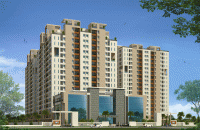
New vs. Resale: Which Home is Right for
You?
- by Akash Pharande, Managing Director - Pharande Spaces
Choosing between buying a new home and a resale property is an important
decision for any homebuyer. They have to weigh factors like cost, convenience,
and long-term value. New homes have the most up-to-date building codes, modern
conveniences, and safety features. Resale homes are ready to move into and are
often in established neighbourhoods.
Knowing the pros and cons of each can help you make a smart investment that fits your lifestyle and financial goals. As with any important decision and for a balanced approach, it is advisable to understand the cons as well as the pros of either option.
Primary Market Properties (New Homes From Developer)
Pros of buying from primary market
Purchasing a home from the first-hand market opens up potential
for personalized financing options, and one is also assured of the latest
amenities and better construction quality. Newly built housing has the benefit
of RERA safeguards, which guarantee transparency to consumers. Moreover, buyers
can overcome the inevitable maintenance pitfalls of older properties when they
buy a new product. Finally, properties bought on the primary market tend to
have stronger resale value.
Buyers can satisfy themselves with regards to the actual
condition of the property, and the neighbourhood is already well established
and generally tends to have more complete infrastructure than around new
projects. Also, there is no GST payable on resale properties. The property will
also be closer its 'expiry date' and therefore to eventual redevelopment, which
can have very good implications for current owners.
Cons of buying from primary market
Buying a home on the primary market generally involves a higher cost, not least
of all because of GST fees applicable on under-construction properties. There
is always a danger of the project getting delayed when one is dealing with
lesser-known players, which can lead to a doubled financial burden of EMI and
rent while you wait.
If a project is delayed, buyers are left with uncertainty about the quality of construction as the developer may cut corners to expedite completion so as to stay RERA compliant. If there is higher volatility in the market, it can impact potential resale value.
Secondary Market Properties (Resale Homes from Owners/Investors)
Pros of buying from secondary market
Buying a home on the secondary market can often involve lower
prices than available on the primary sales market, especially if the sellers is
in a hurry to close the deal. However, this is not a given - if the resale
property is in a high-demand/low-supply area, it may still command a premium.
One distinct advantage is that the property is ready to move in,
and more or less 'plug-and-play'. Also, it is a WYSIWYG - what you see is what
you get - deal. Yet another potential benefit is that of securing a property in
a saturated location where no new supply is coming in.

Cons of buying from secondary market
You may need to ante up more up front capital if the seller is looking for a
cash-component-heavy deal - which can often be the case. You may not be able to
detect less obvious or well-concealed defects in the property. Depending on the
age of the property, home loans may be harder to come by and the wait for
approval may be longer than for a new home.
Perhaps even more importantly, you're settling for older
construction and worn-out fittings, less updated amenities and designs, and may
wind up paying higher maintenance.
There may also be title flaws, especially if the property has
changed hands several times. And finally, the older a property gets, the less
resale value it tends to have - expect, as already stated, if it is in a
saturated but highly popular location where no new supply is coming in.
How to Decide
Much depends on your budget, your timing, and the appetite for or ability to
weather risk. If you want the latest amenities, RERA cover and flexible payment
plans, the primary market is for you. If you value move-in ready homes, less
expensive up-front investment, and existing infrastructure, the secondary
market may be a better bet.
You must factor in the implications of GST or the absence
thereof, the availability of home loans and the terms on offer for each option,
the future resale value of the home, and the legal soundness of the title.
Also, evaluate your options in a given neighbourhood which is particularly
attractive for you due to its proximity to your workplace and your children's
school, and sentimental associations due to the presence of friends or family.
- Advice to
Investors - Primary Market Purchase
Make sure that the project has a RERA registration, that the developer has a
sound reputation, and study the available payment plans- not least of all for
less-than-transparent add-on burdens on your budget. Factor in the possibility
of the project getting delayed, as this can significantly impact your finances.
As general rule of thumb, the better the builder's reputation
is, the likelier is reasonably timely possession. Do not neglect to account for
GST and maintenance costs. Choose a location which has adequate infrastructure
even if the project is new, as your quality of life there and also the eventual
resale value depend on this. Study the market extensively before making a
decision.
- Advice to Investors - Secondary Market Purchase
Pay strong attention to the property title and make sure that the property has
all the necessary legal documentation. You can pay for a professional home
inspection to verify whether there are hidden defects. Check your comfort level
with cash components, which very often play a role in such deals.
Figure out how much you will be paying for maintenance,
considering the age of the property - it is a good idea to ask neighbours about
this as well as possible problems in the project and the location. Take pains
to inform yourself about the going price trends in that area and project so
that you don't wind up paying a higher-than-necessary price.
To Conclude
Generally, purchasing a home from the first-hand market opens up
potential for personalized financing options, and one is also assured of the
latest amenities and better construction quality. Newly built housing has the
benefit of RERA safeguards, which guarantee transparency to consumers.
Moreover, buyers can overcome the inevitable maintenance
pitfalls of older properties when they buy a new product. Finally, properties
bought on the primary market tend to have stronger resale value.
About the Author:

Akash Pharande is Managing Dir
With the recent inclusion of Puneville
Commercial into one of its most iconic
townships, Pharande Spaces tak